XING Visiontype
Pitched and led XING’s Visiontype project — translated a company-wide strategic reset into two user-tested prototypes within an 8-week sprint, validated with 10–12 real users and aligned across every key Product Director and PM in the company.
Role
Design lead
Timeline
2021
Discipline
Strategic prototyping
Scale
8 weeks · 2 iterations

In short
I pitched a “Visiontype” — a strategic prototyping method that paints a picture of a product’s idealised future, grounded in real user research rather than another vision deck — as a way to make a new CPO’s strategic intent tangible enough for the whole company to rally around.
The challenge
By late 2022, XING was struggling — customer activity was declining and the company had lost sight of its core value proposition. A new CPO wanted to pivot strategic direction, but the product organisation was struggling to reorient around it, with no shared, tangible sense of where the company was actually heading.
[Add caption]
Approach
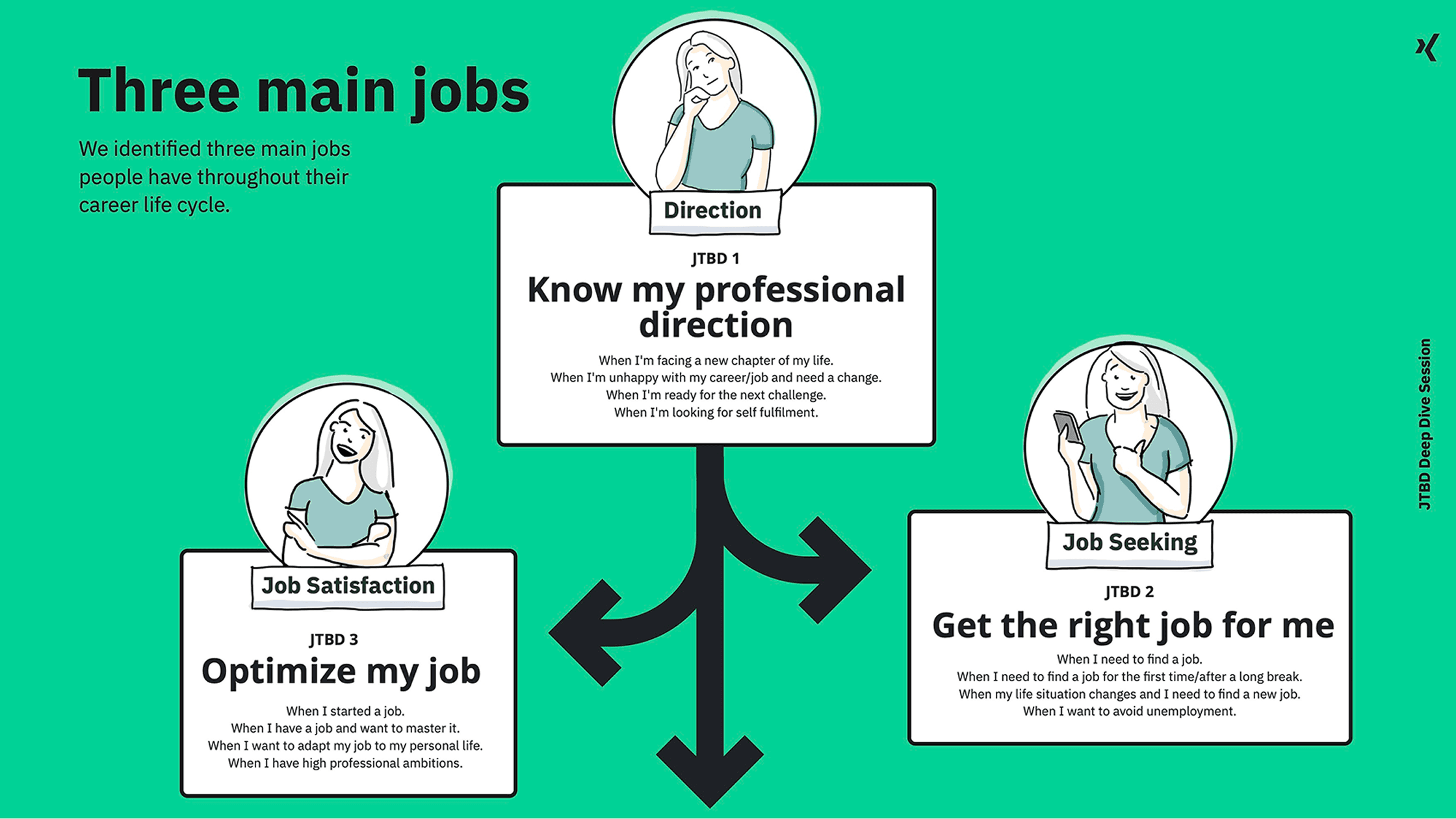
I sold the approach in as a pitch based on the “Visiontypes: A Tool for Strategic Innovation” framework — built for exactly this situation: stagnating growth, a business that’s lost its footing, needing a shared north star. I built on JTBD research the design team had already done, then wrote a one-page briefing to align stakeholders on scope before starting.
I set up a DACI model to formally name drivers, approvers and contributors across the org, co-driving it with a business-side lead and a lean three-designer team. I worked day-to-day with a VP Product as the main stakeholder, with biweekly reviews directly with the CPO, who kept close oversight throughout.

[Add caption]

DACI model was used to define the project stakeholders and information/decision flow
I ran a design sprint stretched to ten days to make room for high-level stakeholder input, narrowing to two directions — “Radical Focus” vs. “Browsability” — before committing to one to prototype. I built an assumption map to focus user interviews on the riskiest, least-proven bets underpinning the new strategy, rather than testing everything.


The fast sketching phase produced diverse ideas and concepts which were discussed and voted on

Ideas were honed into two separate approaches. We decided on direction with our stakeholders and moved to prototyping.
I tested the first prototype with 10–12 users. It validated the navigation and architecture direction, but disproved the hypothesis that career-learning content should lead — I flagged that early and changed direction before the second iteration, delivering a refocused prototype (job-seeker and learner experience, simplified into Start/Jobs/Develop/Me) wrapped up in time for Christmas.

Prototype 1 featured developmental learning content


Assumption mapping helped us make clear recommendations based on known data points
Outcome
shared north star for the org
user interviews per iteration
prototype iterations
weeks (4 sprints)
The project delivered two tested prototype iterations in an eight-week sprint, validated with 10–12 real users rather than leadership opinion alone, and directly informed the following year’s roadmap targets. It became the shared “north star” that Product Directors and PMs across every key business area used to organise their own roadmaps — even without shipping pixel-for-pixel, it was the mechanism that got teams across the company to understand their role in delivering the new direction.

Prototype 2 had a clear focus on the Job seeker experience, which is where the strategic direction finally landed


The plan to rapid prototype succeeded in setting direction in a short time, with fast stakeholder input and decision making
What I’d do differently
My day-to-day stakeholder was a VP Product who was themselves still new to the business — next time, I’d want more direct, regular contact with the CPO, who held the real strategic authority, rather than relying on a stakeholder who was still finding their own footing.
The JTBD research this project built on came from a separate team, and by the time Visiontype kicked off, several of the people behind that original research had already left the company — next time I’d want closer ties to whoever owns that foundational research, rather than inheriting it secondhand.
Postscript: not long after this project wrapped, another C-level change hit, and the clarity the Visiontype had created dissolved into confusion again — a reminder that alignment work like this only holds as long as the leadership sponsoring it stays in place.


We took the project from lo-fidelity to mid-fidelity before sharing with the wider company